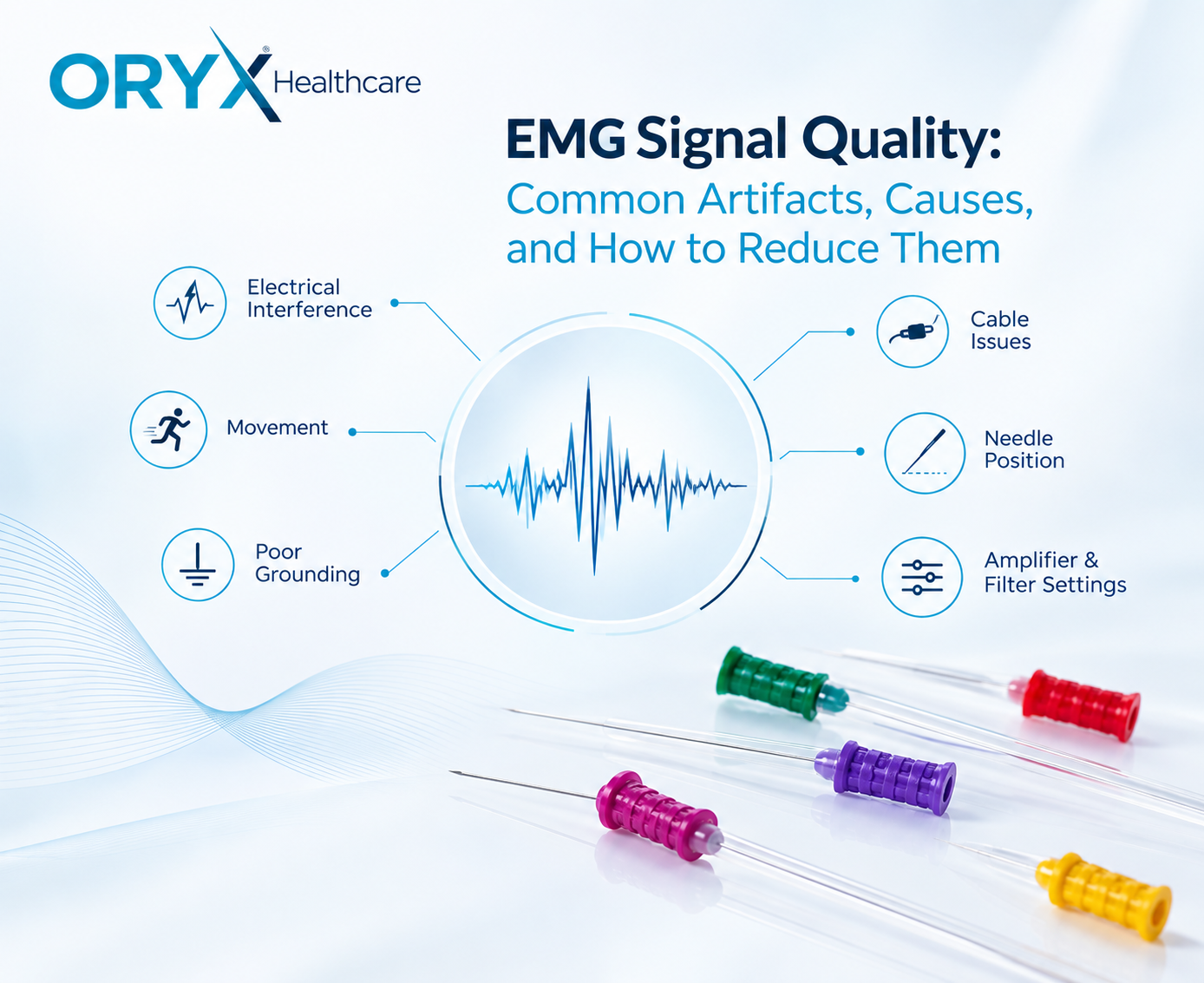
EEMG Signal Quality: Common Artifacts, Causes, and How to Reduce Them
EMG signal quality is an important part of reliable electromyography. A recording may contain real muscle activity, but unwanted signals can also affect it. Common sources include electrical interference, movement, electrode problems, poor connections, and unsuitable recording settings.
In needle EMG, this issue matters because clinicians study several features of the recorded waveform. These include spontaneous activity, motor unit action potentials (MUAPs), recruitment, amplitude, duration, and waveform shape.
A technically poor recording does not always make an examination unusable. However, noise and artifacts can make the waveform harder to read. If a technical artifact looks like real muscle activity, it may also lead to a wrong interpretation.
This article explains the most common causes of poor EMG signal quality. It also shows how artifacts can appear and what practical steps can help reduce them during EMG recording.
What Is EMG Signal Quality?
EMG signal quality describes how clearly an EMG system records muscle activity while limiting unwanted signals.
A good recording should preserve the physiological information that the clinician needs. At the same time, it should limit unwanted components such as:
- Electrical interference
- Baseline noise
- Movement artifacts
- Electrode or cable problems
- Poor grounding
- Unstable electrode contact
- High impedance
- Unsuitable filter or amplifier settings
Modern EMG systems use hardware and software to reduce unwanted interference. Even so, signal contamination can still occur when the recording setup seems correct.
For this reason, identifying the source of unwanted activity should come before trying to remove it with signal processing.
Why Does Signal Quality Matter in Needle EMG?
Needle EMG does more than show whether electrical activity is present.
During a needle examination, the clinician looks at several features of muscle activity. These include:
- Insertional activity
- Spontaneous activity
- Motor unit action potential amplitude
- Duration
- Number of phases
- Recruitment
- Firing patterns
- Stability and waveform shape
AANEM educational material includes these features in its guidance for needle EMG interpretation.
When noise covers part of the waveform, the clinician may have more difficulty identifying or measuring these features. Therefore, signal acquisition is an important part of the diagnostic process.
In other words, signal quality is not only an engineering concern. It also affects how clinicians interpret EMG findings.
Common Causes of Poor EMG Signal Quality
Poor signal quality rarely has only one cause. Instead, several factors can affect the recording at the same time.
1. Electrical Interference
Power-line interference is one of the most common forms of unwanted electrical activity.
Nearby electrical devices, cables, equipment, and the surrounding electromagnetic environment can add periodic noise to an EMG recording. The problem becomes more noticeable when the unwanted signal is large compared with the muscle signal.
AANEM educational material on instrumentation also identifies electrical interference, lead problems, and grounding as important causes of recording problems.
How to reduce electrical interference
Depending on the recording environment, you can:
- Check all electrode and cable connections.
- Keep recording cables in a stable position.
- Inspect connectors and equipment for damage.
- Remove unnecessary electrical devices from the immediate recording area when appropriate.
- Check the grounding and recording setup.
- See whether the interference changes when nearby equipment is switched off.
Most importantly, find the source before using strong filtering.
2. Poor Grounding
Grounding plays an important role in an electrophysiological recording system.
The differential amplifier measures the voltage difference between its inputs. It can also reject signals that appear in a similar way at both inputs. A suitable grounding arrangement and well-matched electrode characteristics can help the system reject unwanted interference.
As a result, poor grounding may increase interference or make the recording less stable.
When unexpected noise appears, check the grounding together with the electrodes, cables, amplifier settings, and nearby electrical equipment.
3. Movement Artifact
Movement can add unwanted low-frequency activity to an EMG recording.
Patient movement, electrode movement, cable movement, or movement of nearby tissue can change the electrical interface. As a result, the system may record signals that do not represent the muscle activity under evaluation.
Much of the research on movement artifacts focuses on surface EMG. However, the basic principle also matters during EMG acquisition: mechanical movement can create electrical contamination.
Needle EMG requires an additional point of care. Even a small change in needle position can change the recorded activity because the electrode samples a local area of muscle.
However, this change is not always an artifact. It may represent a real change in the physiological signal.
Therefore:
A change caused by moving the recording location is not automatically noise.
4. Needle Position
Needle position directly affects what the electrode records.
A needle electrode samples electrical activity from a relatively small area around its recording surface. Therefore, moving the needle can change:
- Which motor units the system detects
- The amplitude of recorded potentials
- MUAP morphology
- The number of visible potentials
- The relationship between the electrode and active muscle fibers
For this reason, consistent electrode placement and a systematic examination approach are important.
Research and consensus work in EMG also emphasizes accurate reporting of electrode placement and electrode characteristics. These factors can affect both the recording and its interpretation.
5. Cable and Connection Problems
Sometimes the electrode works correctly, but the connection between the electrode and EMG system causes the problem.
Common causes include:
- Loose connections
- Damaged cables
- Connector problems
- Intermittent electrical contact
- Cable movement
- Poorly seated plugs
When an unexpected waveform appears, inspect the complete signal path before assuming that the waveform comes from the muscle.
AANEM instrumentation guidance also lists lead problems and electrode malfunction among common technical issues.
6. Electrode Impedance
Impedance is another important factor in electrophysiological recording.
EMG electrodes do not all have the same electrical properties. Research comparing needle electrodes has found differences in resistive and capacitive characteristics, tip area, and noise behavior between electrode types and manufacturers.
The same research also found a strong relationship between noise and resistive characteristics. In addition, electrode tip area can vary considerably between designs.
These differences matter when repeatable recordings are important.
An EMG electrode is more than a mechanical needle. Its geometry, materials, conductive path, and electrical characteristics all affect how the system collects biological signals.
Why consistency matters
If electrode characteristics vary, recordings may also vary for reasons that do not come from the patient’s physiology.
Therefore, consistent electrode characteristics can help provide more repeatable recording conditions in clinical and research settings.
7. Amplifier and Filter Settings
The EMG system also affects the waveform that appears on the screen.
Important settings include:
- Gain
- Input impedance
- Common-mode rejection
- Bandwidth
- High-pass filtering
- Low-pass filtering
- Sampling rate
- Display settings
AANEM educational material notes that filter settings can change waveform amplitude, duration, and configuration. Consequently, unsuitable settings can affect interpretation.
Filtering can certainly help reduce unwanted signals. However, it is not a universal solution.
A filter may remove noise, but it can also change the appearance of the physiological signal. Therefore, the goal should be appropriate signal conditioning, rather than simply using more filtering.
Physiological Activity vs. Technical Artifact
One of the most important parts of EMG interpretation is separating real physiological activity from technical interference.
For example, an unusual waveform does not automatically indicate abnormal muscle activity.
Instead, the clinician can ask several questions:
- Does the activity change when the needle moves?
- Does it continue while the muscle remains relaxed?
- Does it occur at the same time as movement or another physiological event?
- Does the pattern remain after checking the recording setup?
- Can the signal be reproduced?
- Could the signal come from the recording system rather than the muscle?
AANEM educational resources also discuss the need to distinguish true electrical activity from interference, including 60-Hz interference and device-related artifacts.
Therefore, not every unusual waveform represents pathology.
How Can EMG Signal Quality Be Improved?
A systematic troubleshooting process can help identify the source of poor EMG signal quality.
Step 1: Check the electrode
First, confirm that the electrode is properly connected and suitable for the examination.
Step 2: Check the cable
Next, inspect the cable, connector, and lead for damage or intermittent contact.
Step 3: Check grounding
Then, confirm that the ground and reference arrangement is appropriate and stable.
Step 4: Check needle position
If the signal changes unexpectedly, consider whether needle movement has changed the area of muscle being sampled.
Step 5: Check the environment
Look for nearby electrical devices or other possible sources of electromagnetic interference.
Step 6: Check the instrument
After that, review the gain, filters, bandwidth, amplifier configuration, and other acquisition settings.
Step 7: Compare and repeat
Finally, if an unexpected signal remains, repeat the recording after changing one factor at a time.
This step-by-step approach can provide more useful information than trying to remove every unwanted signal with post-processing.
The Role of the EMG Needle Electrode
The electrode creates the connection between the biological signal and the recording system.
In needle EMG, electrode design can affect the electrical characteristics of the recording. Important factors include:
- Recording surface geometry
- Tip characteristics
- Electrical impedance
- Conductive path
- Connection stability
- Manufacturing consistency
- Needle position
- Single-use or reusable configuration
Research comparing needle electrodes has shown differences in electrical properties and noise characteristics between electrode designs.
For that reason, electrode performance should be viewed as part of the complete signal-acquisition chain.
For disposable concentric EMG electrodes, consistent manufacturing and recording characteristics can be especially relevant when clinicians need repeatable acquisition conditions.
Why Signal Quality Starts Before Signal Processing
Modern signal-processing methods can help detect and reduce different types of EMG contamination.
For example, researchers use:
- Filtering
- Adaptive noise cancellation
- Time-domain subtraction
- Wavelet-based methods
- Signal decomposition
- Automated artifact detection
However, these methods do not work in exactly the same way. More importantly, aggressive processing can change the signal that the clinician needs to evaluate.
Therefore, a better approach is:
Prevent → Identify → Correct → Process
rather than:
Record poorly → Filter aggressively
Good acquisition conditions remain the foundation of useful EMG data.
A Practical EMG Signal-Quality Checklist
Before interpreting an unexpectedly noisy recording, consider the following:
| Check | Question |
|---|---|
| Electrode | Is the electrode properly connected and working? |
| Needle position | Is the needle sampling the intended muscle region? |
| Cable | Is the lead intact and stable? |
| Ground | Is the grounding and reference arrangement appropriate? |
| Impedance | Could electrode characteristics contribute to the noise? |
| Movement | Did the patient, needle, or cable move? |
| Environment | Is there nearby electrical interference? |
| Amplifier | Are the acquisition settings appropriate? |
| Filters | Could the filter settings change the waveform? |
| Reproducibility | Does the signal remain after troubleshooting? |
Final Takeaway
High-quality EMG recording depends on several factors working together.
Electrode design, needle position, electrical connections, grounding, instrumentation, environmental conditions, and acquisition settings can all affect the recorded signal.
When an unexpected waveform appears, the first question should not always be:
“What pathology does this represent?”
Instead, ask:
“Is this signal physiological, technical, or a combination of both?”
A systematic troubleshooting process helps separate true muscle activity from technical artifacts. As a result, clinicians can make a more reliable assessment of needle EMG findings.
For EMG electrode manufacturers, this also highlights an important principle:
Signal quality begins at the point of acquisition.
Frequently Asked Questions
What causes noise in an EMG signal?
Common causes include electrical interference, poor grounding, electrode or cable problems, movement, impedance-related issues, and unsuitable acquisition or filter settings.
Does needle position affect EMG signal quality?
Yes. Needle position determines which local area of muscle the electrode samples. Moving the needle can therefore change the motor unit potentials that the system records.
Can an EMG artifact look like real muscle activity?
Yes. Technical interference can sometimes resemble physiological electrical activity. Therefore, clinicians should consider needle movement, reproducibility, the recording environment, and the complete acquisition system when evaluating an unexpected waveform.
Does electrode impedance affect EMG recordings?
Yes. Electrode electrical characteristics, including impedance, can affect noise and recording behavior. Studies comparing needle electrodes have found differences in resistive and capacitive characteristics and related noise.
Can filtering fix a poor EMG recording?
Filtering can reduce certain types of noise and interference. However, it cannot replace good signal acquisition. In addition, excessive or unsuitable filtering can change the waveform.