EMG Needle Size Guide: How Length and Gauge Affect Needle Selection
By ORYX Healthcare
EMG needle size is an important factor when selecting a recording electrode for needle electromyography. However, choosing the right size is not simply a matter of selecting a longer or shorter needle.
The appropriate choice depends on several factors, including muscle depth, patient anatomy, needle length, gauge, electrode design, and the technical requirements of the examination.
For example, a superficial hand muscle and a deep proximal muscle do not have the same anatomical requirements. Therefore, concentric EMG needles are available in different dimensions for different clinical situations.
This guide explains what EMG needle length and gauge mean, why these specifications matter, and which factors clinicians should consider when selecting an electrode.
What Does EMG Needle Size Mean?
When discussing EMG needle size, two measurements are especially important:
- Needle length
- Needle diameter or gauge
Needle length describes how far the electrode can physically reach.
Gauge, on the other hand, describes the diameter of the needle shaft.
These measurements are related, but they do not describe the same thing. A longer needle is not necessarily thicker, and a shorter needle is not always thinner.
In addition, electrode characteristics such as the active recording surface and electrode geometry can influence how an EMG signal is recorded.
The CEDE international consensus project emphasizes that electrode selection can influence EMG recording and interpretation. Therefore, the type and characteristics of the electrode should match the muscle and the information being studied. PubMed
Why Does EMG Needle Length Matter?
The main purpose of needle length is straightforward:
the electrode must be long enough to reach the intended muscle.
Some muscles lie close to the skin. In contrast, others are located beneath subcutaneous tissue or other muscles.
Therefore, the required needle length may depend on:
- Target muscle
- Anatomical location
- Muscle depth
- Patient body composition
- Subcutaneous tissue thickness
- Examination technique
For example, an unnecessarily long needle may be less practical for a superficial target. However, a needle that is too short may not adequately reach a deeper muscle.
For this reason, clinicians should select needle length according to the actual anatomical target rather than use one fixed length for every examination.
AANEM guidance provides a useful example in pediatric electrodiagnostic testing. It recommends using a small needle where appropriate while also stressing that the electrode must still be long enough to pass through subcutaneous tissue and reach the target muscle. AANEM
When Can Shorter EMG Needles Be Useful?
Shorter electrodes can be suitable when the target muscle lies relatively close to the skin.
Depending on the patient and examination, these may include selected muscles in areas such as the:
- Hand
- Face
- Distal upper limb
- Distal lower limb
However, muscle name alone does not determine the correct electrode length.
Two patients undergoing examination of the same muscle can have different amounts of subcutaneous tissue. As a result, the required insertion depth may differ.
Therefore, electrode selection should reflect the individual patient and actual anatomical depth rather than follow a rigid muscle-by-muscle rule.
When Might a Longer EMG Needle Be Needed?
Longer electrodes may be necessary when the target muscle lies deeper beneath the skin.
Depending on anatomy and the clinical approach, examples can include selected muscles in the:
- Thigh
- Hip region
- Shoulder region
- Paraspinal region
- Trunk
However, depth is only one part of the decision.
The examiner also needs to understand the location of the muscle, nearby anatomical structures, and the safest approach to the intended recording area.
A systematic review of needle EMG examination technique emphasizes muscle identification, anatomy, examination technique, and patient-specific considerations such as obesity. PubMed
Therefore, a longer electrode should not be selected simply because “longer is better.” It should provide the reach required for the specific anatomical target.
What Does EMG Needle Gauge Mean?
Gauge describes the diameter of the needle shaft.
At first, the gauge system can seem confusing because a higher gauge number generally represents a thinner needle.
For example:
28G is thinner than 26G, and 26G is thinner than 23G.
However, clinicians should not consider gauge by itself.
Instead, gauge should be evaluated together with:
- Needle length
- Target muscle
- Patient anatomy
- Electrode design
- Recording requirements
- Clinician technique
The exact diameter associated with a particular gauge should also be checked in the manufacturer’s specifications.
Does a Thinner EMG Needle Always Mean a Better Choice?
No.
The thinnest available electrode is not automatically the best choice for every examination.
A smaller diameter may be useful in some situations. However, the electrode must also provide suitable mechanical characteristics for the intended target and required depth.
Therefore, clinicians should consider diameter together with needle length, anatomy, electrode design, and examination technique.
In other words:
Smaller does not automatically mean more appropriate.
The goal is to choose dimensions that are suitable for the specific examination.
EMG Needle Length vs Gauge
It can help to think of the main specifications as answering different questions.
| Characteristic | Main Question |
|---|---|
| Needle length | Can the electrode reach the intended muscle? |
| Needle gauge | What is the physical diameter of the needle? |
| Recording surface | What active area records the electrical signal? |
| Electrode geometry | How is the electrode physically configured for recording? |
These characteristics interact, but they should not be treated as interchangeable.
For example, ORYX currently offers more than one needle configuration with the same length but different diameters and gauges. Oryx Healthcare
ORYX Concentric EMG Needle Sizes
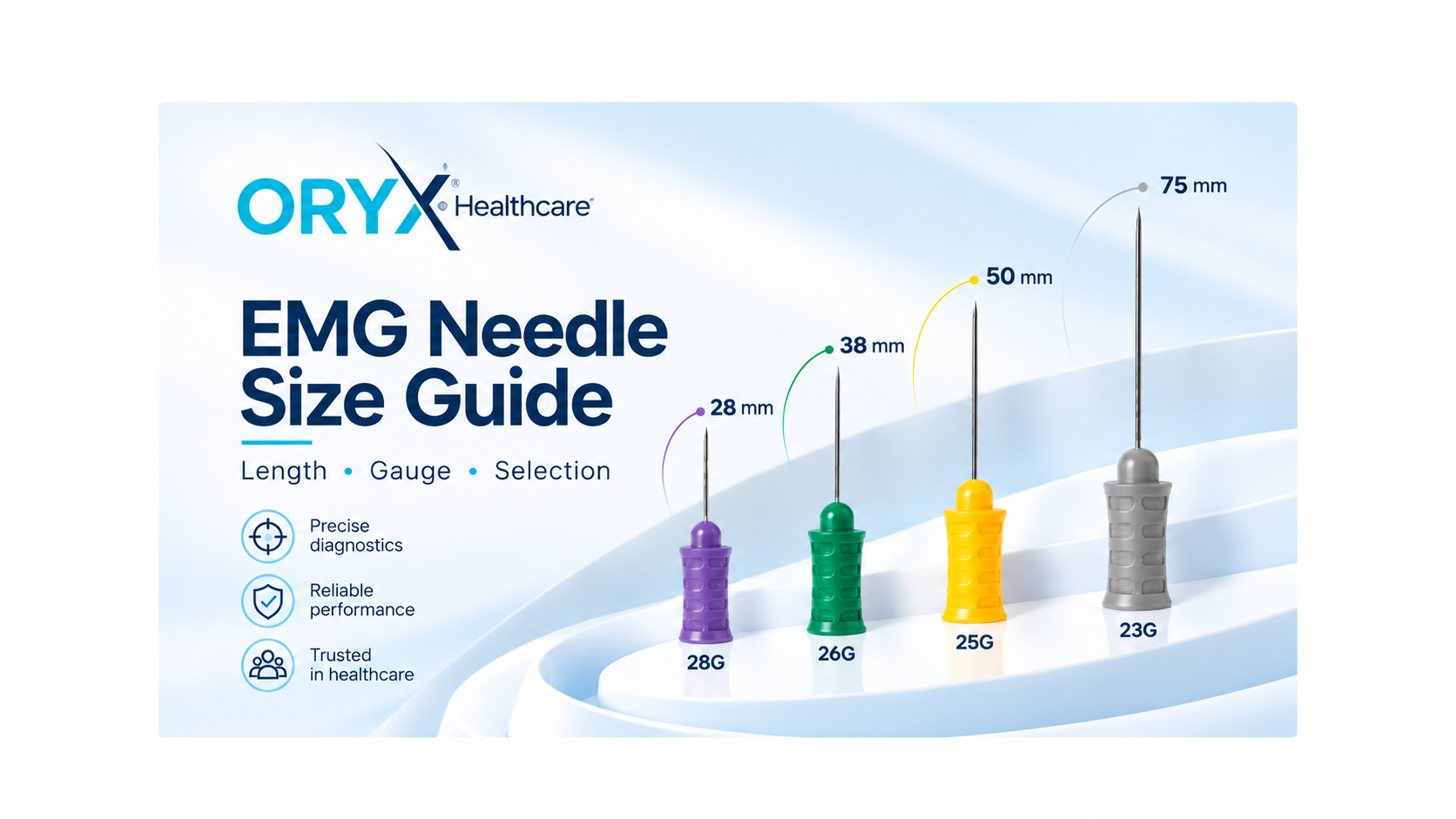
ORYX Healthcare currently offers disposable concentric EMG electrodes in several lengths, diameters, gauges, and recording-surface configurations.
According to the current ORYX product specifications: Oryx Healthcare
| Reference | Length | Diameter | Gauge | Recording Surface* |
|---|---|---|---|---|
| PEN102828 | 28 mm | 0.34 mm | 28G | 0.02 |
| PEN102838 | 38 mm | 0.34 mm | 28G | 0.02 |
| PEN102628 | 28 mm | 0.45 mm | 26G | 0.07 |
| PEN102638 | 38 mm | 0.45 mm | 26G | 0.07 |
| PEN102650 | 50 mm | 0.45 mm | 26G | 0.07 |
| PEN102375 | 75 mm | 0.63 mm | 23G | 0.07 |
*Values shown according to the current ORYX product specification table.
This range provides different electrode dimensions for different anatomical and technical requirements.
However, this table should not be interpreted as prescribing one specific needle size for a particular patient or muscle.
Clinical selection remains dependent on anatomy, examination technique, and professional judgment.
Why Does Recording Surface Matter?
Length and gauge are not the only specifications that influence an EMG electrode.
A concentric needle also contains an active recording surface.
This part of the electrode contributes directly to the electrical characteristics of the recorded signal.
Research comparing EMG needle electrodes has reported meaningful differences in:
- Tip area
- Electrical impedance
- Resistive characteristics
- Capacitive characteristics
- Noise
In one comparative study, noise correlated strongly with resistive characteristics, while electrode tip area varied considerably between different electrode designs and manufacturers. PubMed
Therefore, two needles with a similar length do not necessarily have identical recording characteristics.
For this reason, clinicians and researchers may also need to consider:
- Recording surface
- Electrode geometry
- Electrical impedance
- Noise characteristics
- Manufacturing consistency
Does EMG Needle Size Affect Signal Quality?
Needle dimensions alone do not determine EMG signal quality.
Instead, the recorded signal depends on the entire acquisition system.
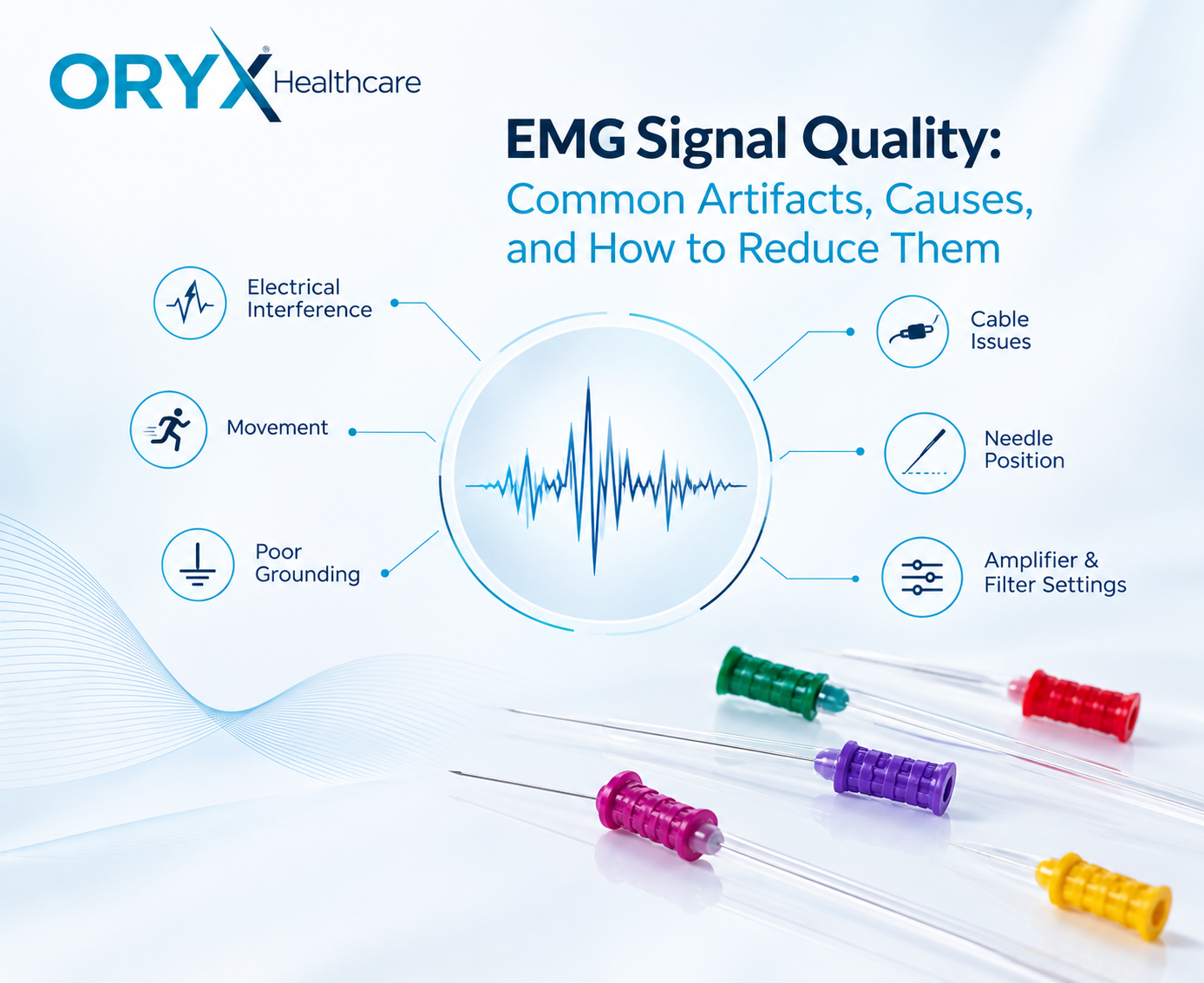
Important factors can include:
- Electrode design
- Needle position
- Distance from active muscle fibers
- Recording surface
- Electrical impedance
- Cable connection
- Amplifier characteristics
- Filter settings
- Electrical interference
Therefore, it would be misleading to claim that one specific gauge automatically produces a better EMG signal.
A more accurate explanation is that needle dimensions form one part of a larger recording system.
Research on needle electrodes has also shown that impedance and recording-surface characteristics can influence noise and electrical recording behavior. PubMed
As a result, appropriate electrode selection should consider both mechanical dimensions and electrical characteristics.
Why Does Patient Anatomy Matter?
The same EMG needle size may not be equally suitable for every patient.
For example, the thickness of subcutaneous tissue can differ significantly between individuals.
As a result, the distance between the skin and the target muscle may also change.
Other anatomical considerations include:
- Muscle size
- Muscle depth
- Nearby blood vessels
- Nearby nerves
- Bone and joint position
- Surrounding muscles
- Patient body composition
Therefore, needle selection is ultimately an anatomical decision as well as a technical one.
Knowledge of anatomy remains essential for safe and effective needle EMG.
A Practical Framework for EMG Needle Selection
Instead of memorizing one needle size for every muscle, clinicians can consider a series of practical questions.
1. Consider the depth of the target muscle
First, determine how far beneath the skin the intended recording area lies.
A superficial target may require less electrode length than a deeper muscle.
2. Assess patient anatomy
Next, consider factors such as subcutaneous tissue thickness and body composition.
These factors can change the distance the electrode needs to travel.
3. Decide whether the target is superficial or deep
Then, evaluate whether a shorter or longer electrode provides sufficient anatomical reach.
4. Consider needle diameter and gauge
After that, assess the physical diameter that is appropriate for the examination.
Gauge should not be considered independently of length and electrode design.
5. Review recording-surface characteristics
In addition, consider the active recording surface and other electrical characteristics of the electrode.
These features can influence the recording environment.
6. Consider the insertion approach
The clinician should also consider surrounding anatomy and the planned path to the target muscle.
A systematic approach helps reduce unnecessary repositioning and supports accurate muscle sampling.
7. Check the manufacturer’s specifications
Finally, verify:
- Length
- Diameter
- Gauge
- Recording surface
- Intended use
- Sterility
- Compatibility
- Product instructions
This step helps ensure that the selected electrode matches the intended application.
Is There One Best EMG Needle Size?
No single EMG needle size is ideal for every examination.
A needle that works well for one anatomical target may not be appropriate for another.
For example, a short electrode may provide sufficient reach for a superficial muscle. In contrast, a deeper target may require a longer electrode.
Similarly, gauge selection depends on more than diameter alone.
Therefore, the better question is not:
“What is the best EMG needle size?”
Instead, clinicians should ask:
“Which electrode dimensions are suitable for this patient, muscle, and recording requirement?”
That approach better reflects the way needle EMG is actually performed.
Why Having Multiple EMG Needle Sizes Matters
A product range with several needle dimensions gives clinicians greater flexibility.
Different anatomical targets can require different combinations of:
- Length
- Diameter
- Gauge
- Recording surface
Therefore, offering more than one configuration allows electrode selection to better match the requirements of the examination.
The current ORYX concentric EMG range includes lengths from 28 mm to 75 mm and gauges from 28G to 23G. Oryx Healthcare
This variation reflects the fact that one electrode dimension cannot address every anatomical situation.
Frequently Asked Questions
What size needle is used for EMG?
There is no single universal needle size for every EMG examination.
The appropriate size depends on the target muscle, anatomical depth, patient anatomy, electrode design, and clinician technique.
What does EMG needle gauge mean?
Gauge describes the diameter of the needle.
Generally, a higher gauge number indicates a thinner needle.
For example, a 28G needle is thinner than a 23G needle.
Does EMG needle length matter?
Yes.
Needle length determines whether the electrode can physically reach the intended muscle.
Therefore, deeper anatomical targets may require longer electrodes.
Is a 28G EMG needle thinner than a 26G needle?
Yes.
A 28G needle has a smaller diameter than a 26G needle.
However, gauge should always be considered together with length and examination requirements.
Does a thinner EMG needle provide better signal quality?
Not necessarily.
Signal quality depends on several factors, including electrode geometry, recording surface, impedance, needle position, cable integrity, filters, amplifiers, and electrical interference.
Therefore, needle gauge alone does not determine recording quality.
What EMG needle sizes does ORYX offer?
The current ORYX product range includes 28 mm, 38 mm, 50 mm, and 75 mm lengths.
Current gauge configurations include 28G, 26G, and 23G. Oryx Healthcare
Final Takeaway
Choosing an EMG needle size is not about finding one electrode that works for every examination.
Instead, clinicians should match the electrode to the anatomical and technical requirements of the study.
For superficial targets, a shorter or finer electrode may be suitable. However, deeper muscles may require additional length.
At the same time, length and gauge should not be considered separately from electrode geometry, recording-surface characteristics, and patient anatomy.
Ultimately, the appropriate selection depends on:
Target depth + Patient anatomy + Electrode characteristics + Recording requirements + Clinical technique
For this reason, access to several concentric EMG needle sizes can support a more flexible approach to needle electromyography.
References
- Besomi M, et al. Consensus for experimental design in electromyography (CEDE) project: Electrode selection matrix. Journal of Electromyography and Kinesiology. 2019;48:128–144. DOI: 10.1016/j.jelekin.2019.07.008. PubMed
- Menkes DL, Pierce R. Needle EMG muscle identification: A systematic approach to needle EMG examination. Clinical Neurophysiology Practice. 2019;4:199–211. DOI: 10.1016/j.cnp.2019.08.003. PubMed
- American Association of Neuromuscular & Electrodiagnostic Medicine. The Utility and Practice of Electrodiagnostic Testing in the Pediatric Population. AANEM
- Joynt RL. The selection of electromyographic needle electrodes. Archives of Physical Medicine and Rehabilitation. 1994;75(3):251–258. DOI: 10.1016/0003-9993(94)90024-8. PubMed
- ORYX Healthcare. Concentric EMG Electrode — Size Table and Product Specifications. Oryx Healthcare
Medical information disclaimer:
This article is intended for professional and educational purposes only. Electrode selection and needle EMG examinations should be performed by appropriately trained healthcare professionals based on patient anatomy, clinical judgment, product instructions for use, and applicable clinical standards.
EMG Needle Size Guide: How Length and Gauge Affect Needle Selection
By ORYX Healthcare
Choosing the right EMG needle size is not simply a matter of selecting a longer or shorter electrode.
During needle electromyography, the recording electrode must reach the intended muscle while allowing the examiner to position and control it appropriately. As a result, needle length, diameter, gauge, recording area, target-muscle depth, patient anatomy, and examination technique can all influence electrode selection.
A superficial hand muscle and a deep proximal muscle do not present the same anatomical requirements. Therefore, different concentric EMG needle dimensions are available for different clinical situations.
This guide explains what EMG needle length and gauge mean, why they matter, and what clinicians should consider when selecting a needle electrode.
What Does EMG Needle Size Mean?
When discussing EMG needle size, two measurements are especially important:
Length — how far the needle can physically reach.
Gauge or diameter — the thickness of the needle shaft.
These characteristics should be considered separately.
A longer needle is not necessarily thicker, and a shorter needle is not always finer.
In addition, other electrode characteristics—including the recording surface and electrode geometry—can affect how electrical activity is recorded.
The CEDE international consensus project emphasizes that electrode selection influences both EMG recording and interpretation, and that the appropriate electrode type depends partly on the muscle and the information being studied. PubMed
Why Does EMG Needle Length Matter?
The primary role of needle length is straightforward:
the recording electrode must be long enough to reach the intended muscle.
Some muscles are located immediately beneath the skin, while others lie below layers of subcutaneous tissue or other muscles.
Therefore, appropriate length depends on several factors:
- Target muscle
- Anatomical location
- Depth of the muscle
- Patient body composition
- Subcutaneous tissue thickness
- Examination approach
A needle that is unnecessarily long may be less convenient for a superficial target, while a needle that is too short may not adequately reach a deeper muscle.
AANEM guidance provides a useful example in pediatric electrodiagnostic testing: it recommends using the smallest suitable needle while also emphasizing that the electrode must still be long enough to pass through the subcutaneous tissue and reach the target muscle. AANEM
This illustrates an important principle:
Needle selection should provide sufficient anatomical reach without using more needle length than the examination requires.
Short EMG Needles: When Are They Useful?
Shorter needle electrodes can be appropriate when examining relatively superficial muscles.
Examples may include selected muscles in areas such as:
- Hand
- Face
- Distal upper limb
- Distal lower limb
However, the examiner does not choose a needle based only on the name of the muscle.
Patient anatomy matters.
For example, two patients undergoing examination of the same muscle may have different amounts of subcutaneous tissue. Therefore, the depth that the electrode must travel can differ substantially.
This is why needle length should be selected according to the actual anatomical target and individual patient, rather than by following a fixed rule for every muscle.
When Might a Longer EMG Needle Be Needed?
Longer electrodes can help reach muscles located deeper beneath the skin.
These may include certain proximal or deep muscles of the:
- Thigh
- Hip region
- Shoulder region
- Paraspinal region
- Trunk
A systematic review of needle EMG examination technique emphasizes the importance of accurate muscle identification, anatomy, safe needle positioning, and modification of the examination for factors such as obesity and other patient-specific considerations. PubMed
Accordingly, needle length is only one part of the decision.
The clinician must also know:
where the muscle is, how deep it is, what structures surround it, and what information is needed from the examination.
What Does EMG Needle Gauge Mean?
Gauge describes needle diameter.
However, the numbering system can initially seem counterintuitive:
A higher gauge number generally represents a thinner needle.
For example, a 28G needle is thinner than a 23G needle.
The exact diameter associated with a particular gauge should always be confirmed from the manufacturer’s specifications.
ORYX, for example, offers concentric EMG electrodes with diameters including 0.34 mm, 0.45 mm, and 0.63 mm, corresponding to different gauge configurations in its current product range. Oryx
Does a Thinner EMG Needle Always Mean a Better Choice?
No.
Using the thinnest possible electrode is not automatically correct for every examination.
A smaller diameter may be desirable in some settings, but an EMG needle also requires sufficient mechanical characteristics for the intended muscle and depth.
The electrode must provide appropriate handling while maintaining the recording configuration needed for the examination.
In pediatric testing, AANEM specifically recommends minimizing needle size when possible to reduce discomfort, while still requiring enough length to reach the intended muscle. AANEM
For adult examinations, however, the most appropriate balance depends on:
- Target muscle
- Depth
- Required needle length
- Patient anatomy
- Electrode design
- Clinician technique and preference
Therefore, smaller does not automatically mean more appropriate.
Length vs Gauge: What Is the Difference?
It helps to think about them as answering two different questions.
| Characteristic | Main question |
|---|---|
| Needle length | Can the electrode reach the intended muscle? |
| Needle diameter / gauge | What physical diameter does the electrode have? |
| Recording surface | What electrical recording area does the electrode provide? |
| Needle geometry | How does its physical design support positioning and recording? |
These factors interact, but they should not be treated as interchangeable.
For example, ORYX currently offers both 28 mm and 38 mm needles with a 28G configuration, while other models combine longer lengths with larger diameters. Oryx
ORYX Concentric EMG Needle Sizes
ORYX Healthcare currently provides a range of disposable concentric EMG electrodes with different lengths, diameters, gauges, and recording-surface specifications.
According to the current ORYX product specifications: Oryx
| Reference | Length | Diameter | Gauge | Recording Surface |
|---|---|---|---|---|
| PEN102828 | 28 mm | 0.34 mm | 28G | 0.02 mm² |
| PEN102838 | 38 mm | 0.34 mm | 28G | 0.02 mm² |
| PEN102628 | 28 mm | 0.45 mm | 26G | 0.07 mm² |
| PEN102638 | 38 mm | 0.45 mm | 26G | 0.07 mm² |
| PEN102650 | 50 mm | 0.45 mm | 26G | 0.07 mm² |
| PEN102375 | 75 mm | 0.63 mm | 23G | 0.07 mm² |
This range allows the electrode dimensions to be selected according to the anatomical and technical requirements of the examination.
Important: this table describes the ORYX product range. It should not be interpreted as prescribing a particular needle size for a specific patient or muscle.
Why Does Recording Surface Matter Too?
Length and gauge are not the only relevant specifications.
A concentric needle also contains an active recording surface.
The dimensions and geometry of this surface influence the electrical characteristics of the recording.
Classic research comparing different EMG needle electrodes found substantial differences in electrode tip area, electrical characteristics, impedance, and noise between electrode designs and manufacturers. The authors highlighted consistent recording-area characteristics as particularly important for repeatable quantitative recordings. PubMed
This means two electrodes that have similar lengths do not necessarily behave identically.
When considering an EMG needle, clinicians and researchers may therefore need to consider:
- Length
- Diameter
- Gauge
- Recording surface
- Impedance
- Electrode geometry
- Connection characteristics
Does EMG Needle Size Affect Signal Quality?
Needle dimensions alone do not determine signal quality.
The recorded signal depends on the entire acquisition environment, including:
- Electrode design
- Position within the muscle
- Distance from active muscle fibers
- Recording surface
- Electrode impedance
- Cable connection
- Amplifier characteristics
- Filter settings
- Electrical interference
AANEM instrumentation guidance emphasizes that high-quality electrophysiological recording depends on appropriate electrodes, amplifier characteristics, impedance, and signal-processing conditions. AANEM
Therefore, it would be incorrect to say:
“A particular gauge produces a better EMG signal.”
A more accurate statement is:
Needle dimensions are one part of a larger recording system, and the appropriate electrode should match the anatomical and technical requirements of the examination.
How Do Other Concentric EMG Needle Systems Approach Size?
Multiple established manufacturers offer concentric needle electrodes in different dimensions.
For example, Ambu currently lists six needle lengths ranging from 25 mm to 75 mm for its Neuroline Concentric product line. Ambu
This variety across established EMG product ranges reflects a basic clinical reality:
one electrode size cannot efficiently address every anatomical situation.
The objective is not to identify one universally “best” size.
Instead, the clinician needs a suitable range from which to choose.
A Practical Framework for EMG Needle Selection
Rather than memorizing one needle size for each muscle, clinicians can think through several questions.
1. How deep is the target muscle?
The needle must reach the intended recording location.
2. How much subcutaneous tissue is present?
Individual anatomy can significantly change the required depth.
3. Is the target relatively superficial or deep?
This helps guide the required electrode length.
4. What diameter is appropriate for the examination?
The answer may depend on the target, required length, electrode design, and clinician preference.
5. What recording surface does the electrode provide?
Electrical characteristics matter alongside mechanical dimensions.
6. Are there nearby structures that affect the insertion approach?
Knowledge of anatomy remains essential to safe and effective needle EMG.
7. What does the manufacturer specify?
The exact length, diameter, gauge, recording surface, sterility, compatibility, and intended use should always be verified in the official product information.
EMG Needle Selection Is an Anatomical Decision
There is an understandable temptation to ask:
“Which EMG needle size should I use?”
But the more useful question is:
“Which electrode dimensions are appropriate for the muscle and patient I need to examine?”
Needle EMG is an anatomical and physiological examination.
Therefore, electrode selection should reflect:
target depth + patient anatomy + recording requirements + clinician technique.
This is more meaningful than choosing a needle based on gauge or length alone.
Frequently Asked Questions About EMG Needle Size
What size needle is used for EMG?
There is no single universal EMG needle size. The appropriate length and diameter depend on the target muscle, anatomical depth, patient characteristics, electrode design, and clinician preference.
What does gauge mean for an EMG needle?
Gauge refers to needle diameter. In general, a higher gauge number represents a thinner needle.
Is a 28G EMG needle thinner than a 26G needle?
Yes. Within standard gauge notation, 28G represents a smaller diameter than 26G.
When is a longer EMG needle required?
Longer electrodes may be required when the target muscle lies deeper beneath the skin or when more subcutaneous tissue must be traversed.
Does a thinner EMG needle give a better signal?
Not necessarily. Signal quality depends on many factors including electrode design, recording surface, position, impedance, amplifier characteristics, filters, and the recording environment.
What EMG needle sizes does ORYX offer?
The current ORYX concentric EMG electrode range includes lengths of 28, 38, 50, and 75 mm, with diameter and gauge configurations including 28G, 26G, and 23G. Oryx
Final Takeaway
Choosing an EMG needle size is not about finding one electrode that works for every examination.
The appropriate choice depends on the depth of the target muscle, patient anatomy, electrode length and diameter, recording characteristics, and clinical technique.
Shorter and finer electrodes may suit some superficial examinations, while deeper targets may require additional length.
At the same time, length and gauge should not be considered separately from electrode geometry and recording-surface characteristics.
Ultimately:
the right EMG needle is the one that appropriately matches the anatomical target and recording requirements of the examination.
References
- American Association of Neuromuscular & Electrodiagnostic Medicine (AANEM). The Utility and Practice of Electrodiagnostic Testing in the Pediatric Population: An AANEM Consensus Statement. AANEM
- Menkes DL, Pierce R. Needle EMG muscle identification: A systematic approach to needle EMG examination. Clinical Neurophysiology Practice. 2019;4:199–211. DOI: 10.1016/j.cnp.2019.08.003. PubMed
- Besomi M, et al. Consensus for experimental design in electromyography (CEDE) project: Electrode selection matrix. Journal of Electromyography and Kinesiology. 2019;48:128–144. DOI: 10.1016/j.jelekin.2019.07.008. PubMed
- The selection of electromyographic needle electrodes. Study indexed in PubMed. PubMed
- American Association of Neuromuscular & Electrodiagnostic Medicine. EDX Instrument Design. AANEM
- ORYX Healthcare. Concentric EMG Electrode — Product Specifications. Oryx
Medical information disclaimer: This article is intended for professional and educational information. Electrode selection and needle EMG examination should be performed by appropriately trained healthcare professionals according to patient anatomy, clinical judgment, applicable instructions for use, and local practice requirements.